

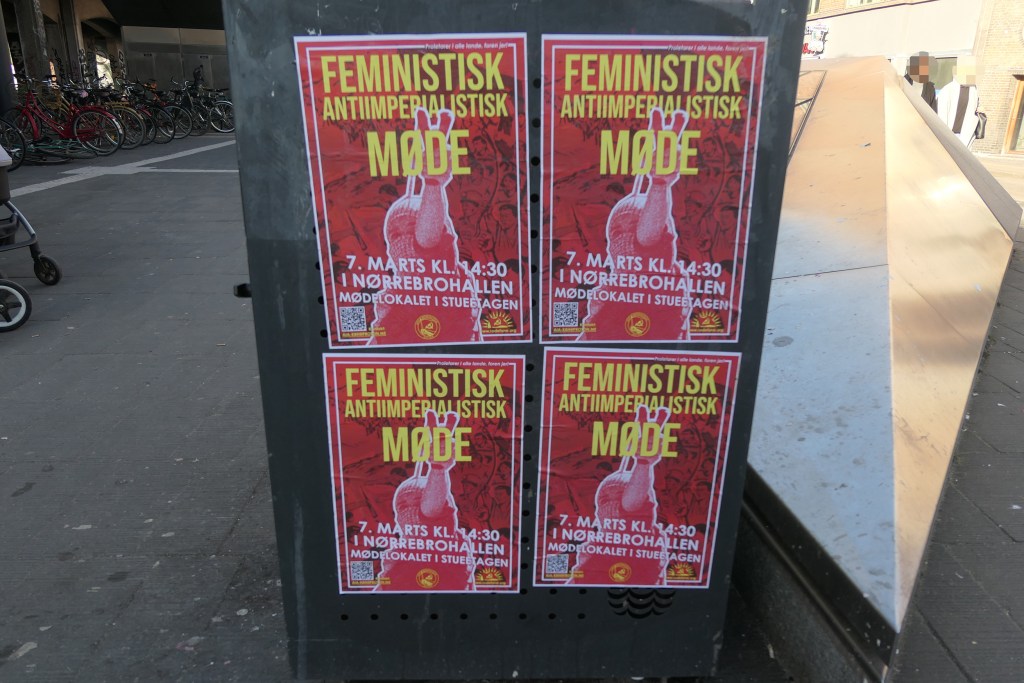
We hereby share a statement of the Committee Red Star on occasion of the 8th of March that was sent to us:
Proletarians of all countries, unite!
RAISE THE STRUGGLE FOR A REVOLUTIONARY WOMEN’S MOVEMENT!
Central committee – Committee Red Star
March 2026
Long live International Working Women’s Day!
International Working Women’s Day, March 8, is approaching once again. It is a great historic day of struggle, which working and peasant women around the world have used for over 100 years to develop the struggle against patriarchal oppression of women and the capitalist class society that perpetuates it. It has been a day for major strikes and public meetings, and a day for forging greater fighting spirit. Everywhere in the world where the oppressed classes rise up to fight and wage people’s war against their oppressors, the struggle for the creation of a revolutionary women’s movement is also being raised. A movement with the aim of gathering and leading the best sons and daughters of the working people into organized struggle against patriarchy and all oppression of women, as an integral and indispensable part of the revolutionary struggle against imperialism and capitalism, and as a force in the construction of socialism.
Patriarchal oppression and the attack on women’s dignity
Everywhere, the capitalist ruling class tries to split the oppressed classes to stop them from coming together and uniting in the fight for freedom. To combat solidarity between the sexes among workers, the ruling classes have created and developed patriarchy as a comprehensive system of ideology, prejudice, traditions, laws, economic inequalities, and culture. All of this serves to maintain the double oppression of working women. Not only are they wage workers and exploited by capitalism, they are also burdened with the vast majority of reproductive labour in the home, without any compensation. Reproductive labour in the home consists of ensuring that the labour power of the working class is a commodity that must be renewed every day (and every generation) in order to continue to be sold on the labour market. This reproductive labour consists of many aspects and forms, such as cooking, laundry and cleaning, bringing up children and caring for them, etc., and is an absolutely fundamental prerequisite for the maintenance of society. Precisely because it is such a central prerequisite for the maintenance of society and requires such a large total amount of labour, it has enormous value, which stands in stark contrast to its economically unpaid and culturally denigrated character in capitalist society. In order to maintain the oppression of women, bourgeois ideology must demean them and the labour they are forced to perform. It is a workload that “does not deserve compensation” because it is in “a woman’s nature” to submit and serve her husband and family. Whether it is with appeals to ancient sacred scriptures or the reactionary, pseudoscientific “biological truths” of “incel culture”, it is ultimately about maintaining an entire sector of the necessary labour of society as naturally being “women’s housework”. Its true character as valuable labour, as valuable reproduction of labour power, is obscured so that it can continue as unpaid labour. The worker in a bakery, the daycare worker, the educator, and the laundry worker are fully recognized as “workers” with the right to wages for their labour, but within the four walls of the home, women are denied this recognition, and this is justified by bourgeois ideology with the most despicable attacks on their dignity and equality.
Wave upon wave, blow upon blow, against imperialism and patriarchy!
Throughout all previous forms of society, the struggle of oppressed women against patriarchy has taken place under the most unfavorable material conditions. In ancient and medieval agricultural societies, the women’s struggle could not develop into an organized mass phenomenon because most of the population was scattered in small villages, and transportation and communication technologies were too primitive. However, with the development of capitalism and industrialization throughout the 19th century, major changes took place that changed these conditions. There was enormous urbanization, with former agricultural workers being concentrated in large cities and squeezed into factories by the thousands. At the same time, the development of industry also required major advances in transportation and communication technology. This new capitalist industrial society created the conditions necessary for the organization of a powerful proletarian women’s movement. Women workers in factories and densely populated proletarian neighborhoods were able to coordinate and share experiences, and a growing solidarity and fighting spirit emerged. From the outset, the revolutionary socialist movement stood on the side of working women and united the struggle for women’s rights and equality with the struggle for the liberation of the entire working class. Lenin said at the first All-Russian Congress of Working Women in 1918, “The position of women has until now been such that it can be called the position of slaves; women are held down by housework, and only socialism can bring them out of this position. […] The experience of all liberation movements has shown that the progress of the revolution depends on the extent to which women participate in it.” As more women were employed in industrial production, a trend that was particularly accelerated by the two world wars, more women organized themselves in the revolutionary movement of the working class and led the growing organization of struggles for women’s rights and for the wages and working conditions of working women. It was through the founding and building of the Communist Parties that the women’s struggle reached its highest expression, as it was only through these parties that the working class was able to organize the struggle against patriarchal oppression as an integral part of the struggle for revolution across society as a whole.
Today, with the working class in Denmark lacking its own party, the central organizer of the class, because the Communist Party of Denmark was liquidated from within by bourgeois opportunists shortly after the party had led the resistance against the nazi occupation, the working class now also lacks a revolutionary women’s movement. Re-establishing the revolutionary women’s movement is a task that is central to the re-founding and reconstitution of the Communist Party of Denmark, because these struggles would be completely impossible without the involvement of working-class women. Without women leaders, cadres, fighters, and the broad participation of working women in the popular mass movement, no victory can be achieved. The revolutionary movement must understand that the integration of the women’s struggle into the revolution is of crucial importance. Those who do not take the organization of the proletarian women’s struggle seriously have, in practice, closed their doors to half of the working class and done great harm to the revolution.
The women’s struggle must be better integrated into revolutionary work, and the foundations must be laid for the creation of a revolutionary women’s movement.
It is necessary for the revolutionary movement today to redouble its efforts to correct the mistakes and shortcomings that stand in the way of creating a revolutionary women’s movement. This requires a serious and sincere application of the ideology of the working class, scientific Marxism, including, in particular, the willingness to engage in self-critical corrective work. It is no easy task to correct mistakes, especially when it comes to deeply ingrained problems that have had a long time to take root. The power of habit is strong and cannot be broken without conscious and sincere struggle. It is important to recognize that the revolutionary movement in Denmark has, until now, not dealt with the question of organizing the proletarian women’s struggle correctly. This must be changed now, not later. A fundamental development in thought and practice must be fought for. Petty bourgeois patchwork solutions are useless if fundamental changes are desired; for example, when we look back at history and at other organizations, we can see a general tendency on the “left wing” to reduce the women’s struggle to small internal women’s committees within the self-proclaimed “revolutionary” organizations, where women comrades have been parked and told by their male comrades that it is their responsibility to “take care of women’s issues.” Then these organizations can go around telling people how “seriously” they take the women’s struggle. The result is that the proletarian-feminist struggle is separated from the rest of the revolutionary struggle, instead of being an integral part of every single struggle; whether it be workers’ organizing in the workplace, neighborhood defense against demolition and gentrification, or international solidarity work, etc. Women comrades have often talked about how the development of their strengths and leadership skills was hampered by being boxed into a marginalized internal committee with no connection to the rest of the revolutionary work, which their male comrades did not consider to be “part of the women’s struggle.” A long petty-bourgeois revisionist tradition in Denmark has created a set of ideological, political, and organizational criteria for dealing with the women’s struggle based on subjectivism, amateurism, and liberalism, which has helped prevent the creation of a revolutionary women’s movement.
To rectify this, it is essential to understand how the establishment of the Committee Red Star two years ago marks a major milestone in the development of the revolutionary movement. The committee represents a leap forward toward the formation of a leading revolutionary center for the working class in Denmark, determined to forge a national organization of communists in formation, with the goal of refounding and reconstituting the Communist Party of Denmark, for the initiation of the armed socialist revolution, the People’s War, serving the proletarian world revolution. With the formation of the Committee Red Star, the revolutionary forces in Denmark have overcome the biggest factor in the tendency toward dispersion and disorganization, and the class struggle in Denmark now has the opportunity to correct the mistakes and deviations that have been allowed to take root in the absence of a revolutionary center. These mistakes are neither banal nor have they come about by themselves. They are deep-rooted diseases brought into the revolutionary movement of the working class from the reactionary bourgeois society in which the movement finds itself. They are consequences of the internal economic logic of bourgeois society, as well as ideological narratives of justification and culture that have taken deep root in the workers’ movement. They will not disappear on their own, but must be confronted consciously and systematically; bourgeois ideology must be crushed by proletarian ideology in sharp two-line struggle. Therefore, the solutions to these problems cannot be trivial, spontaneous, or handled in an unorganized manner. In order to succeed in rectifying the mistakes and creating a revolutionary women’s movement, the struggle must be broad and involve all organs and organizations of the revolutionary movement. At the same time, it must be carried out consciously, disciplinedly, and systematically, which requires correct and just leadership from a revolutionary leading center, armed with the ideology of the working class, Marxism-Leninism-Maoism, principally Maoism, with the contributions of universal validity of Chairman Gonzalo. With this text and the subsequent work of implementing its policies, this responsibility is taken up by the Committee Red Star and the revolutionary movement.
In order for the rectification process and the struggle for the creation of a revolutionary women’s movement can be realized, a thorough rectification campaign must be launched. First, each of the existing organizations in the revolutionary movement must take up the struggle to ensure that the proletarian women’s struggle is integrated into the work of each organization and at every level. This must be done through the implementation of strengthened ideological-political education, two-line struggle, criticism/self-criticism, and an increased focus on all comrades participating in conscious proletarian-feminist work. Next, after the integration of the proletarian-feminist struggle and the development of strong female leaders, a special proletarian-feminist women’s struggle organization must be created, which can function as the vanguard of the proletarian women’s struggle and the highest concentrated expression and organizer of the women’s movement in Denmark. The Committee Red Star considers the formation of such a women’s organization to be one of the most important tasks of the revolutionary movement today in the struggle for the refounding and reconstitution of the Communist Party of Denmark.
Three bourgeois diseases that must be eradicated:
In order for there to be a leap forward in the development of proletarian-feminist work and for the foundation to be laid for the creation of a revolutionary women’s movement, it is necessary for the revolutionary movement to fundamentally break with the dominant bourgeois ideological, political, and organizational criteria in its work today; bourgeois diseases brought into the workers’ movement from the bourgeois society in which it exists, which manifest themselves as subjectivism, amateurism, and liberalism.
1. Subjectivism
One of the three bourgeois diseases that must be crushed is subjectivism. Since the liquidation of the Communist Parties after World War II, the organization of the women’s struggle has been under great pressure. Bourgeois feminism, especially in its postmodern form, has fought hard to steer working women’s struggles away from class-conscious revolutionary struggle. In contrast to postmodernism, a significant proletarian current developed in the 1960s and 1970s, inspired by Mao Tse-tung Thought and the Great Proletarian Cultural Revolution, guided by scientific socialism and organized along class lines. However, the proletarian-feminist movement suffered a major setback with the onset of the general counter-revolutionary counteroffensive of imperialism in the late 1980s and 1990s, which resulted in the women’s movement being dissolved into bourgeois postmodernism and petty-bourgeois organizational criteria. With the dominance of bourgeois postmodern ideology came the replacement of Marxism’s Materialist Objectivism with the bourgeoisie’s Idealist Subjectivism. Instead of the scientific development of new concrete knowledge through class struggle, the subjectivity and attitude of the individual have been elevated to the sole yardstick, and the individual’s personal experience has been made sacred truth. The struggle for the liberation of working women from patriarchal oppression has thus, despite rhetorical objections from postmodernists, been shifted from the arenas of society, the economy, and class, and instead centered in the inner arena of the individual. Against this ideological decay in the workers’ movement, the importance of creating revolutionary proletarian class organizations that can organize the struggle along clear class lines and principles based on the experiences and needs of the working class becomes clear. In this, the scientific ideology of the working class plays its central role as a guide to action and illuminates the correct methods of work.
Subjectivism is not isolated to the women’s struggle or any other specific struggle, but has taken deep root in all aspects of society. If subjectivism is to be thoroughly crushed and scientific Marxism is to dominate the workers’ movement, then the reconstitution of the headquarter of the working class, its leading center, the Communist Party, is required, which can lead the development of theoretical and practical work across all areas of the class struggle. With the development and construction of Committee Red Star, this reconstitution of the vanguard of the working class is brought nearer and nearer. The scientific development of new theory and practice, through organized class struggle, is what will enable the proletarian women’s movement to develop in the face of any opposition, correct its mistakes, carry out strong and precise blows against the class enemy and patriarchy, and contribute to ensuring the victory of the socialist revolution. All organizations in the revolutionary movement must confront subjectivism in their work and fight for the consistent application of scientific Marxism in everything they do. When campaigns and actions are carried out, scientific analysis of their processes and results must be carried out consistently and systematically, their success must be evaluated concretely, and the experiences must be summarized.
2. Amateurism
The second disease that has been prevalent since the liquidation of the Communist Party, and has been particularly dominant in the “left wing” since the 1960s, is amateurism. It denies the need for the working class to form professional and organized fighting organizations, and fetishizes anarchist small-group organizational principles. Amateurism seeks to justify the dissolution of revolutionary forces into isolated local small circles and study groups, deeply preoccupied with petty-bourgeois and inconsequential “activism”. Focus is given to what requires the least organization and can best be carried out on a purely recreational/hobby level, rather than the more complex organization on a larger coordinated scale that necessarily requires division of labor, specialization, and the formation of professional cadres, which are necessary to make it possible to organize the working class in the various sectors of the class struggle. Since the liquidation of the Communist Party, there has been no shortage of self-proclaimed “revolutionary” small groups, alienated and isolated from the working class, more concerned with promoting themselves externally using the most revolutionary-sounding phraseology and symbols than with actually being involved in the organization of class-conscious organizations of struggle within the mass movement. Such amateurism, cut off from the real class struggle in society, can neither produce revolutionary leaders nor attract the most advanced elements of the working class to the struggle. Instead, they can only develop self-important small local “chiefs” and petty-bourgeois “activists.” Amateurism primarily attracts the youth of the petty bourgeoisie and the intellectual middle strata, who have no real experience in the labour market or class struggle, nor any sincere desire to gain such experience, as this would require a degree of self-sacrifice and inconvenience, and the courage to put their privileged class position at risk. This should remind us of the importance of focusing our efforts on organising the poorest and most oppressed sections of the working class, and the necessity of organising the workers’ struggle in their workplaces. Amatuerism is also clearly evident in many organizations’ approach to the women’s struggle, which is most often treated as an afterthought by self-proclaimed “revolutionary” organizations. The tendency has been to treat the women’s struggle as a separate area of work within the organisations, where female comrades are parked without help, support, planning or organisation. The result is internal “women’s groups”/“women’s committees”/“affinity groups,” which are subsequently used to ward off accusations that the women’s struggle is not taken seriously in the organisation. All revolutionaries must understand that the proletarian women’s struggle must be integrated into all the struggles of the revolutionary movement, and that it is the responsibility of all comrades, regardless of gender, to dedicate themselves to ensuring that this is done on an organized basis.
Another way in which amateurism has harmed the struggle for the creation of a revolutionary women’s movement is that it neglects the work of finding concrete, organized solutions for the women comrades of the movement to the practical problems that patriarchy specifically imposes on them and which make it significantly more difficult for many women comrades to dedicate themselves to the revolutionary struggle to the extent that they would actually like to. One example is child daycare issues. Women comrades who are mothers, especially single mothers, find that it can be a major challenge to be as active in revolutionary work as they would like to be when they also have problems organizing daycare. Such a problem affects both women comrades who are already organized in the movement and deters potential new women comrades from joining the movement. Problems like this must be solved collectively and in an organized manner by revolutionary organisations through the mobilisation of, for example, family members, partners, neighbours, etc. to help with collective childcare. It may also be male comrades who take turns to provide collective care for several of the women comrades’ children. Male comrades should be more than willing to sacrifice attending a meeting or action once in a while if it means helping to create an organization with the best conditions and opportunities for their women comrades’ participation and development. Regardless of the specific solution reached, and there may be any number of them, the most important thing is that the solution is well-organized and well-planned, and takes the specific situation into account. If such a solution can ensure the systematic establishment of the best conditions for the development of revolutionary women leaders, then nothing should delay or prevent the organized implementation of these solutions.
With the development of the Committee Red Star over the last two years, a major step has been taken towards uniting the revolutionary forces in Denmark into a single national movement, with a single revolutionary center. Although this has been an important blow against the small-group organizational methods of amateurism, there are still many ideological and political remnants of the petty-bourgeois small-group mentality. Some comrades find it harder than others to accept the development of organized division of labor and specialization, and yearn for simpler times when each individual comrade did not have to coordinate much with others and was essentially free to decide for themselves how and when a task should be carried out. Isn’t this individual style of work exactly the same as that of the small independent producer, of the petty bourgeoisie? Doesn’t it have clear limitations tied to the abilities of the individual, rather than the collective abilities of the organization? Is it not clear that something as large and complex as the organization of a revolutionary women’s movement cannot be achieved on the basis of an “every man for himself” mentality? In order to eliminate amateurism in general in the organizations of the revolutionary movement, the style of work must be transformed. It must be organized and given clear structures, and comrades must take on clear responsibilities. Each organization must consciously analyze how it currently performs its tasks and take up two-line struggle on how best to improve its methods of work. Efforts must be made to establish effective communication and coordination between comrades so that effective division of labour and specialisation can be achieved. Leading comrades must be trained in how best to divide and delegate tasks to different comrades and on how to best organise an effective overview of local work.
3. Liberalism
The third disease is liberalism. It is the most toxic of the three diseases and the one that must be fought with the hardest and most uncompromising struggle. Liberalism refers to the attitude whereby Marxist principles are replaced by bourgeois behavior. Where principled two-line struggle is set aside in favor of unprincipled peace for the sake of “friendship” or due to “pragmatic” excuses. An attitude where, for example, racism, sexism, and male chauvinism are overlooked within one’s own ranks. Isn’t this kind of behavior tragically common in many organizations that pride themselves on being “progressive”? Where such behavior is excused as “ironic/edgy” or “just for fun.” An attitude that has protected patriarchal and racist environments and cultures within “left-wing” organizations and driven out many of the most advanced revolutionary women and minorities in order to protect a few male opportunists. You don’t have to have been on the “left wing” in Denmark for long to have encountered such behavior, which is why Committee Red Star has fought it relentlessly since our founding. But this is not a struggle that can be won in a single battle. It is a protracted struggle that must be waged as long as the society we live in continues to be reactionary and liberal. Regarding this liberal attitude, it is important to understand what Chairman Mao Tse-tung said about the dangers of liberalism among the ranks of revolutionaries:
“Liberalism, on the other hand, rejects ideological struggle and advocates unprincipled peace. It engenders a decadent and petty-bourgeois attitude and leads to political decay among certain groups and individuals in the party and revolutionary organizations. […]
To let things slide for the sake of peace and friendship when someone has clearly made a mistake, and to refrain from a principled discussion because the person in question is an old acquaintance, perhaps from one’s own town, a schoolmate, a close friend, someone one cares about, an old colleague, or a subordinate. Or to touch on the issue briefly instead of going into it thoroughly in order to maintain a good relationship. The result is that you harm both the organization and the person. […]
To let things take their wrong course if they do not directly affect you. To say as little as possible, even though you know very well what is wrong, to remain worldly-wise in the background and just try to keep your own back free. […]
Listening to erroneous opinions without refuting them and even hearing counterrevolutionary statements without drawing attention to them, but taking it quite calmly and pretending nothing has happened. […]” (Mao Tse-tung, Combat Liberalism)
We must be resolute in eradicating liberalism from the ranks of the revolutionary movement. Liberalism must be systematically confronted and crushed through sincere and consistent two-line struggle, organized rectification campaigns, and clear demands that those who express liberal attitudes such as sexism or racism be subject to clear requirements for rectification and self-criticism or exclusion. Under no circumstances should there be room for people who actively try to evade the two-line struggle in the movement’s democratic forums or who try to use intrigue to enforce their ideological or political positions. For it to be possible to create a revolutionary women’s movement, there must also be an unwavering dedication to maintaining a proletarian-solidarity internal organizational environment and culture in which strong women cadres and leaders can be developed.
All organizations in the revolutionary movement in Denmark have a clear duty to bring up all the problems described above for discussion at all levels and with all comrades, and to begin developing concrete plans for carrying out campaigns to combat subjectivism, which denies the role of the scientific ideology of the working class and the role of class struggle in the development of correct revolutionary theory and practice, amateurism, which denies the necessity of organization and discipline, makes effective division of labour and specialization impossible, and prevents the achievement of real and lasting results, and liberalism, which “is a manifestation of opportunism and is fundamentally opposed to Marxism. It is negative and in reality helps the enemy. That is why the enemy is happy to see it preserved among us. That being the case, there can be no place for liberalism in the ranks of the revolution.” (Mao Tse-tung, Combat Liberalism)
Long live International Working Women’s Day!
Raise the struggle for a revolutionary women’s movement!
Forward toward the refounding and reconstitution of the Communist Party of Denmark!
Central committee – Committee Red Star
March 2026
 Røde Fane